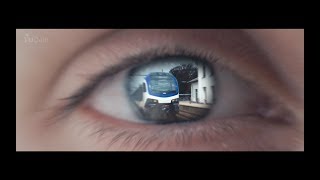
Railway Engineering: An Integral Approach

Have you ever wondered what it takes to get your train on the right platform at the scheduled time every day?
Journey with us into the world of rail - a complex system that connects people, cities and countries.
Railway systems entail much more than a train and a track. They are based on advanced technical and operational solutions, dealing with continuously changing demands for more efficient transport for both passengers and freight every day. Each system consists of many components that must be properly integrated: from trains, tracks, stations, signaling and control systems, through monitoring, maintenance and the impact on cities, landscape and people. This integration is the big challenge and the source of many train delays, inconvenient connections and other issues that impact our society.
This engineering course attempts to tackle those issues by introducing you to a holistic approach to railway systems engineering. You will learn how the system components depend on each other to create a reliable, efficient and state-of-the-art network.
We will address questions such as:
  • How do railways work and how did they evolve over time?
  • How do different components of the railway system interact?
  • What is the effect of railways from an urban, social and economic point of view?
  • What can be done to improve the monitoring and maintenance of tracks?
  • How are timetables designed in a way that balances passenger demand with the capacity of the railway and is adaptable to handle unexpected disturbances?
  • How to prevent and deal with disturbances caused by external factors?
  • How does the design of railways influence their performance over time?
A new serious game has been designed for this course to guide you through the process of decision making while building a rail network and maintaining it. Cities have to be connected in an ever-changing setting, dealing with wear, capacity, developments and disturbances. How will your choices affect the performance of the system?

What you'll learn

  • Identify the name and function of the main railway network components
  • Evaluate the influence that railways exert on their environment and vice versa
  • Explain the different methods of train control and their effect on timetabling and safety
  • Understand the effects and the internal and external factors of disturbances on railway operations
  • Identify the different methods of dealing with system degradation and the effects of interaction between the components
  • Explore the state-of-the-art and future developments of railway systems
Are you an expert in the field?While this MOOC introduces different aspects of the railway network, if you want to go into more detail, gain advanced knowledge and expertise for your daily work, you can enroll in our follow-up online professional education courses.

ENROLL ON EDX

Comments

Popular posts from this blog

Créer votre application Web avec Java EE

Si vous souhaitez acquĂ©rir des compĂ©tences en  Java EE , ce cours est pour vous. Java EE  ( Java Enterprise Edition ) est un standard de dĂ©veloppement d’ applications  d’ entreprises  multi-niveaux, basĂ©es sur des  composants . La plate-forme  JEE  prĂ©sente une solution optimale pour dĂ©velopper des applications robustes, sĂ©curisĂ©es et Ă©volutives. On parle gĂ©nĂ©ralement de plate-forme  Java EE  pour dĂ©signer l’ensemble constituĂ© des  services  ( API ) offerts et de l’infrastructure d’exĂ©cution. Je suis sĂ»r que vous souhaitez dĂ©velopper votre  application Web  rapidement! Donc, vous ĂŞtes au bon endroit. Si tel est le cas, ce cours vous convient parfaitement, car il contient des exemples concrets et des tactiques permettant de dĂ©velopper diffĂ©rents types d'applications avec  Java EE . Je sais comment y parvenir et je souhaite partager cette connaissance avec vous! Qu'allez-vous apprendre dans ce cours?...

Java Programming Language for Beginners

If you are looking at gaining skill in  java , this course is for you. Java is an  object-oriented programming language  created by James Gosling and Patrick Naughton, employees of  Sun Microsystems , with the support of Bill Joy (co-founder of Sun Microsystems in 1982), officially presented on May 23, 1995 at SunWorld Sun was then acquired in 2009 by  Oracle , which now owns and maintains Java. The peculiarity and central purpose of Java is that software written in this language must be very  easily portable  on several  operating systems  such as Unix, Windows, Mac OS or GNU / Linux, with little or no modifications. I am sure you want to grow your language quickly! So you are in the right place. If so - this course is a great fit for you, because it contains real-world  examples  & tactics for developing different types of  programming in java . I know how to achieve that, and I want to share this knowledg...

CRS-17 Mission - SpaceX

SpaceX is targeting Saturday, May 4 for an instantaneous launch of its seventeenth Commercial Resupply Services mission (CRS-17) at 2:48 a.m. EDT, or 6:48 UTC, from Space Launch Complex 40 (SLC-40) at Cape Canaveral Air Force Station, Florida. Dragon will separate from Falcon 9’s second stage about 9 minutes after liftoff and attach to the space station on Monday, May 6. The Dragon spacecraft that will support the CRS-17 mission previously supported the CRS-12 mission in August 2017. Following stage separation, SpaceX will attempt to recover Falcon 9’s first stage on the Of Course I Still Love You droneship, stationed in the Atlantic Ocean.